
Enterprise Data Security 2025: A Strategic Defense Shield Against Cyber Threats
Cyber threats are getting more complex in 2025. Protect your business and earn trust with enterprise data security and privacy compliance.
Enterprise Data Security 2025: A Strategic Defense Shield Against Cyber Threats
As digitalization permeates every part of the business world, data has undoubtedly become the most valuable enterprise asset. By 2025, with both the number and complexity of cyber threats rising, enterprise data security is no longer just a technology issue — it has become a strategic imperative that protects a business's existence, reputation and future.
The 2025 Cyber Threat Landscape
In 2025, the cyber threat environment is shaped by next-generation threats such as AI-powered attacks, Ransomware-as-a-Service and complex supply chain attacks. These threats no longer target only large enterprises; they are aimed at organizations of every size in critical sectors such as finance, healthcare, retail and the public sector. Their goal is to capture valuable data — from financial records and sensitive patient information to customer data and intellectual property.
Layered Enterprise Security Architecture
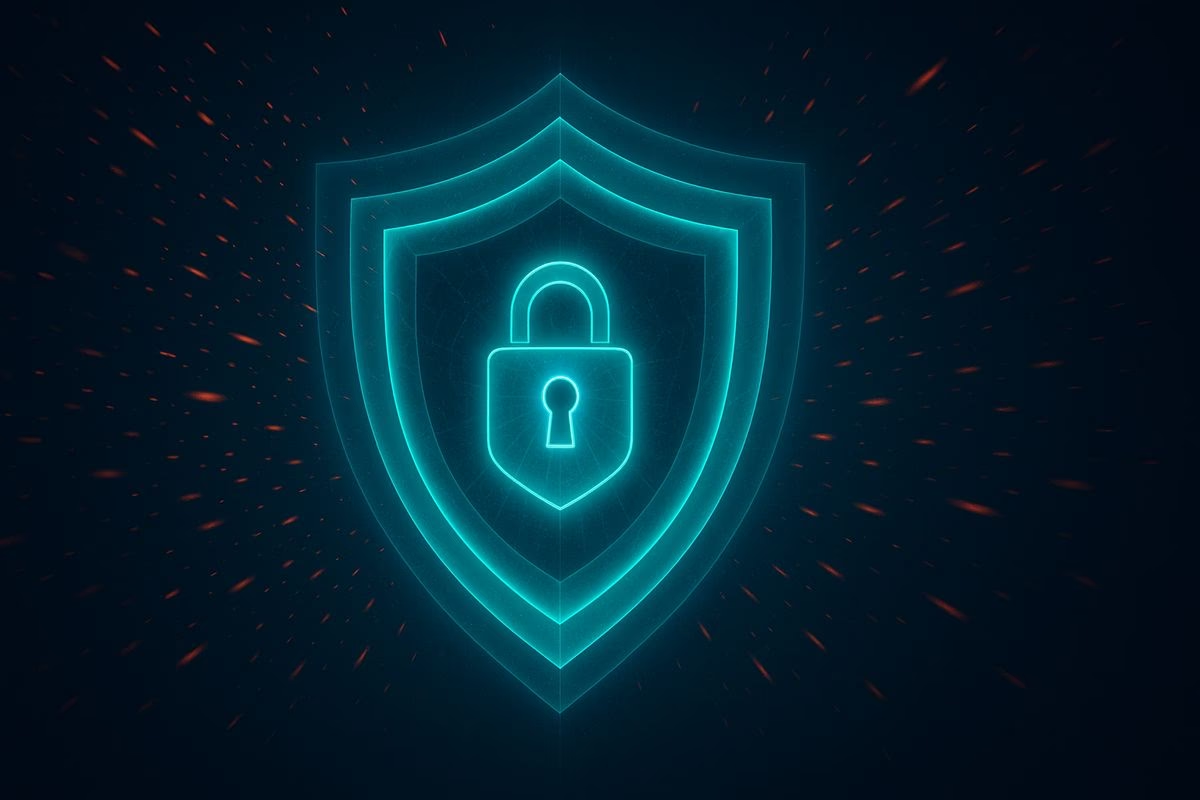
Effective protection against modern cyber threats requires a multi-layer security architecture. Instead of concentrating defense at a single point, this approach creates protection layers at different levels to make life harder for attackers. The layers include next-generation firewalls at the network level, Web Application Firewall (WAF) solutions for application security, encryption technologies that protect data both at rest and in transit, and advanced endpoint security solutions that protect end-user devices.
Privacy and Data Protection Compliance
For organizations operating in Türkiye, the most important legal dimension of enterprise data security is the Personal Data Protection Law (KVKK); for those serving EU customers, the GDPR applies similarly. These laws require personal data to be processed lawfully, accurately, for a specific purpose and proportionately. To stay compliant, organizations must keep their data registry filings (such as VERBİS in Türkiye) up to date, fulfill their obligation to inform data subjects and establish valid consent mechanisms where explicit consent is required.
Core Technical Security Solutions
A solid security architecture is built on a few foundational technology solutions. Identity and Access Management (IAM) ensures the right people access the right resources through mechanisms such as multi-factor authentication (MFA) and role-based access control (RBAC). Security Information and Event Management (SIEM) systems monitor all network activity in real time, detect suspicious activity and trigger incident response. Vulnerability Management aims to proactively detect and close potential gaps through regular security scans and penetration tests.
Security Operations and Continuity
The effectiveness of technology solutions is completed by well-managed security operations. A Security Operations Center (SOC) monitors systems 24/7, actively hunts threats and responds quickly in case of a security incident. A successful Incident Response Plan clearly defines the steps (detection, isolation, eradication, recovery) to take during an attack. Disaster Recovery and Business Continuity plans guarantee continuity by defining how quickly and with how much data loss systems can return to normal (RTO/RPO) after a cyber disaster.
Future Security Trends
Cybersecurity is in constant evolution. In the future, AI and machine learning will be used more widely to detect threats proactively and develop automated response systems. Zero Trust Architecture, based on the "never trust, always verify" principle, will maximize security by treating every access request inside the network as suspicious. Quantum threats will reshape encryption standards as quantum-resistant cryptographic algorithms emerge.
Security Culture: The Strongest Line of Defense
Even the most advanced technologies fall short in environments where the human factor is weak. Building a strong security culture is therefore vital. Regular security awareness training, phishing simulations and secure coding practices raise the bar for employees and form one of the most effective lines of defense against cyber attacks.
Conclusion
In 2025 and beyond, enterprise data security is not just a technological requirement — it is a strategic investment to protect assets, reputation and customer trust. With a comprehensive security approach, you can protect your assets, comply with regulations such as KVKK and GDPR and gain competitive advantage as a trusted partner in the market.
At VEX-I Technology we deliver tailored enterprise data security and privacy compliance strategies. By protecting your business against cyber threats, we enable you to move forward confidently on your digital transformation journey.
Share:
Digital Transformation Strategies: Prepare Your Business for the Future