
Data Security and Privacy Compliance: Data Protection in the Digital Age
Personal data protection is no longer just a legal obligation — it's a strategic factor that builds trust and competitive advantage. How do you achieve KVKK/GDPR compliance?
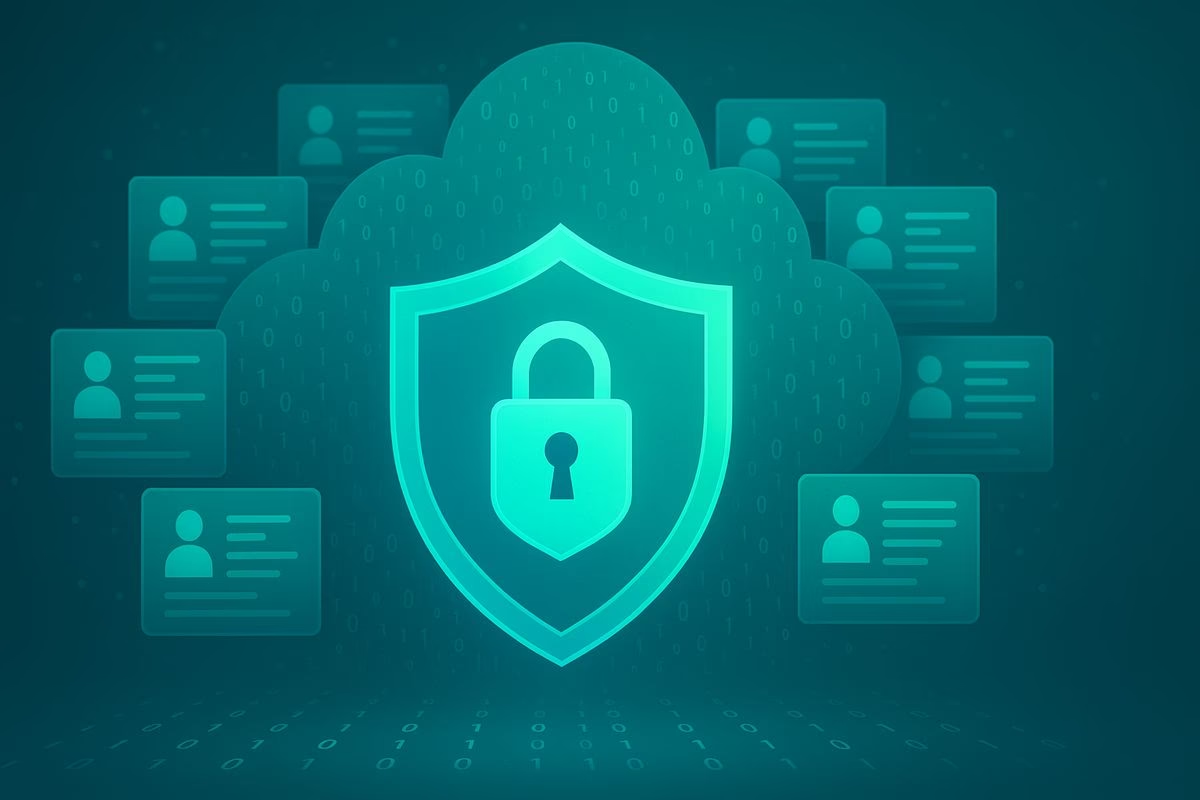
Data Security and Privacy Compliance: Data Protection in the Digital Age
In a rapidly digitizing world, the protection of personal data is no longer just a legal obligation. It has become the cornerstone of earning customer trust, protecting brand reputation and gaining competitive advantage. A comprehensive data security strategy and full compliance with privacy regulations such as Türkiye's KVKK (Personal Data Protection Law) and the EU's GDPR are therefore strategic priorities for every organization.
Core Principles and Data Subject Rights
Privacy laws such as KVKK and GDPR enforce certain core principles in personal data processing. Data must be lawful, accurate and up to date, processed for specific, explicit and legitimate purposes, and limited and proportionate to those purposes. Data must only be retained for the period required by relevant legislation. The laws also grant important rights to data subjects: every individual has the right to learn which of their data is processed, request correction or deletion of inaccurate data and know with whom their data has been shared.
Multi-Layered Data Security Strategies
Effective data security requires a multi-layered approach that combines both technical and physical measures. Technical security measures include encryption of data both at rest and in transit. Mechanisms such as role-based access control (RBAC) and multi-factor authentication (MFA) ensure that only authorized people access the data. Physical security measures cover protecting data centers against physical access, surveillance with security cameras and disaster recovery plans for emergencies.
Cyber Threat Management and Proactive Defense
The digital world is full of constantly evolving threats — phishing, malware and DDoS attacks. To defend proactively, it is critical to monitor all network traffic in real time with Security Information and Event Management (SIEM) systems, detect suspicious activity with Intrusion Detection Systems (IDS) and run regular vulnerability scans. In the event of a security breach, having a pre-prepared Incident Response Plan plays a vital role in minimizing the damage.
Data Classification and Lifecycle Management
Not all data is equally sensitive. That's why data classification — separating data into categories such as personal, sensitive personal, commercial and operational — is essential to prioritize security measures correctly. The entire data lifecycle (collection, processing, storage and secure disposal) must be managed in line with privacy principles. Adopting the Privacy by Design principle means systems are designed from the start with data privacy at the center.
Compliance Processes and Incident Management
Achieving privacy compliance requires systematic work. The first step is to build a data inventory that covers every data source within the organization. Based on this inventory, data processing activities are mapped, legal bases are determined and — under the principle of transparency — privacy notices are prepared. In the event of a data breach, the process must be planned in advance: detection of the breach, mobilization of the response team and notification of affected individuals and regulatory authorities within the required timeframe (e.g. 72 hours under GDPR) — these steps enable fast and correct action in a crisis.
Training and Awareness: The Strongest Line of Defense
Even the most advanced security technologies can fall short against vulnerabilities introduced by the human factor. Regular training of all employees on privacy and cybersecurity is therefore the foundation of a security culture. Phishing simulations and updates on current threats turn employees into the strongest line of defense.
Conclusion
Data security and privacy compliance is a dynamic process that requires continuous attention and effort. It is not just a legal obligation — it's a necessity for surviving in the digital age, earning customer trust and achieving sustainable success. With a comprehensive, proactive and education-focused approach, you can protect your most valuable asset — your data — and look to the future with confidence.
At VEX-I Technology we draw on our expertise in data security and privacy compliance to strengthen your data protection foundation and partner with you reliably on your digital transformation journey.
Share:
Scalable UI Architecture With Micro-Frontends: The 2025 UI Revolution